Gyumri–Kars
The Armenian Gyumri–Akhurik section and its connection to Türkiye: the corridor, railway systems and decisions needed before international trains can run.
Evidence audit
What is actually confirmed
The point is not to make the project look more certain than it is. The point is to make the known parts easy to read and the unknown parts impossible to miss
28 Apr 2026 · official
Joint working group met in KarsArmenia and Türkiye held a joint working group meeting specifically on rehabilitation and operationalization of the Gyumri–Kars railway
official network status
Cross-border rail interface existsTCDD’s network statement identifies Doğukapı–Ahuryan as a closed border-crossing railway interface connected to Armenia
network difference
Gauge change is realArmenia uses 1520 mm broad gauge while Türkiye uses 1435 mm standard gauge
still unresolved
Design details remain openTrack geometry, exact works scope, handling logic, funding structure and operating arrangements still await the official design phase
The corridor and its interfaces
Follow the connection from Kars to Gyumri, the border procedures and the gauge interface. These are explanatory diagrams, not surveyed alignments.
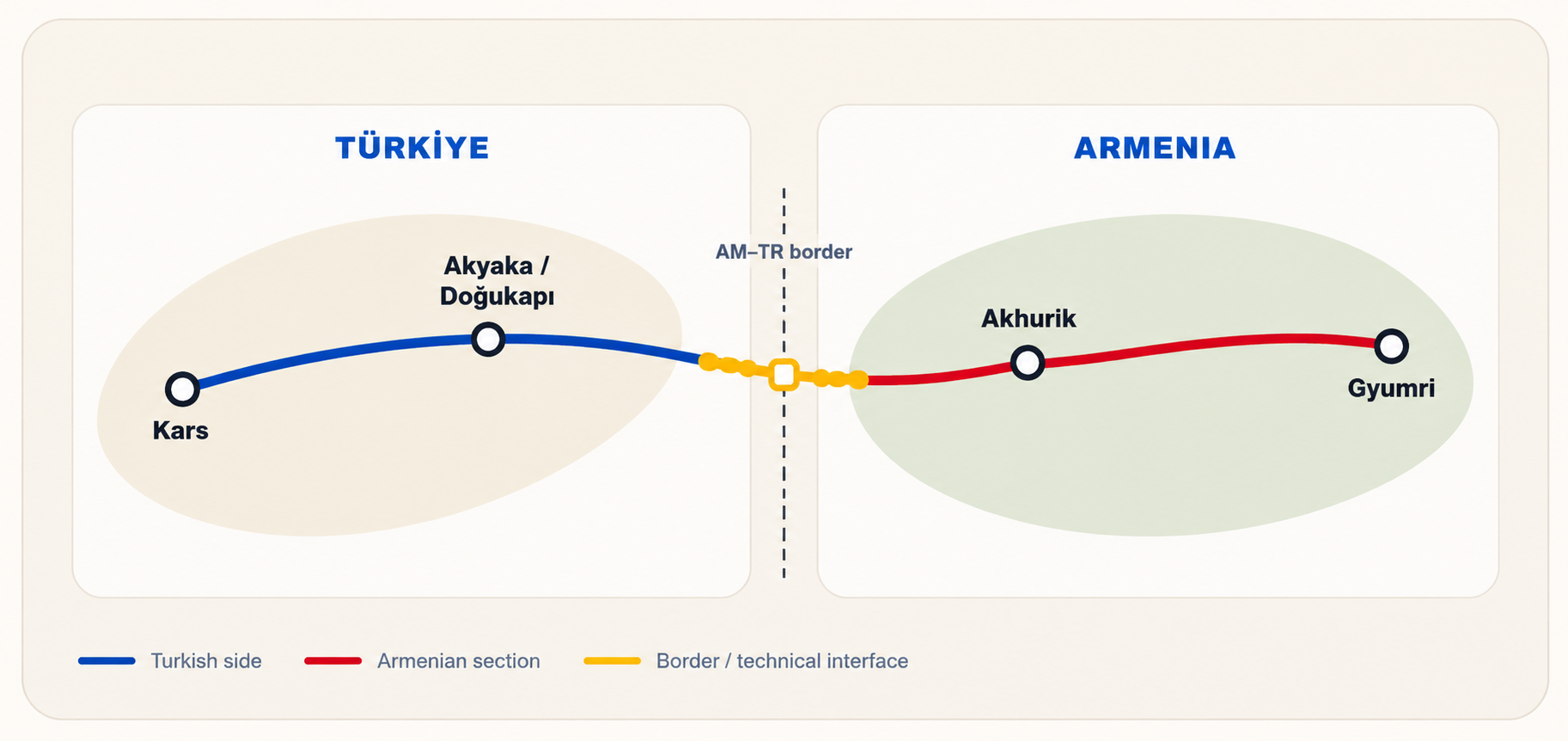
Local corridor map
A schematic corridor view showing Kars, Akyaka / Doğukapı, the border interface, Akhurik and Gyumri. It does not show a final engineered alignment
How the connection works
The corridor combines infrastructure restoration, a border crossing and an interface between two railway systems. Each part has to be ready before an international service can operate.
Show the geography and the cross-border relationship
Do not invent final geometry, signalling or station layouts
The gauge interface is one of the defining conditions of the project
The tender is important, but it is still one step on the way to service
Operational chain
The operational sequence from Kars to Gyumri, separating the railway, border and technical interfaces
1520 mm meets 1435 mm
The principal technical interface between Armenia’s 1520 mm system and Türkiye’s 1435 mm system
What the interface may require
The interface has several technically plausible solution families. The official design process must compare them and select the operating arrangement
Transshipment terminal
- Passengers or freight transfer between systems
- Operationally simple to explain
- Could add handling time and terminal requirements
Bogie / wheelset exchange
- Rolling-stock interface handled at a technical point
- Useful where through movement matters
- Needs suitable facilities, procedures and equipment
Gauge-changing / dual-gauge approach
- A more infrastructure-heavy response
- Potentially powerful but design-dependent
- Best kept open until official design narrows the field
What can be shown now
- That the line reconnects two different railway gauges
- Where the interface question belongs in the corridor
- That multiple technical solution families are possible
- That the final choice has operating, border and terminal implications
What should remain open
- The exact location and layout of interface facilities
- Which solution is preferred by the official design team
- Whether freight, passengers or both are treated first
- Detailed infrastructure and procurement consequences
From tender to service
The announced design stage is material, but operation still depends on surveys, engineering, procurement, works, testing and bilateral border arrangements
Design procurement
The project enters official design work on the Armenian section and defines the terms for survey, engineering and corridor decisions
Survey + existing-condition audit
The line, structures, formation, crossings, station areas and technical constraints must be measured and assessed rather than assumed
Engineering + gauge-interface choice
The design team has to determine what the restored line includes and how the 1520 / 1435 system break is handled
Construction procurement
Only after design can the Armenian side move to a construction tender and a clearer funding / delivery structure
Rehabilitation + testing
The corridor would then need works, systems installation, testing, certification and practical operating readiness
Border & operating agreement
Service needs more than track. Border procedures, operator arrangements and practical train-handling rules all have to work together
The core message
The corridor can and should be visualized, but it should be visualized as a carefully framed reconstruction-and-interface project rather than as a finished engineering design
Project status
Corridor diagram: schematic
Future engineering solution: pending official design
Opening date: not yet known
Primary references used here
The diagrams are schematic interpretations of the public sources below; they are not official engineering drawings
- Ministry of Foreign Affairs of Armenia — Regarding the Meeting of the Joint Working Group between Armenia and Türkiye for the Rehabilitation and Operationalization of the Gyumri-Kars Railway, 28 April 2026
- TCDD 2025 Network Statement, Annex 3.2.2 — lists Doğukapı–Ahuryan as a closed border-crossing railway interface and identifies Armenia’s network as 1520 mm broad gauge
- Public ministerial reporting cited in Armenian media about the international design procurement process for the Armenian Gyumri–Akhurik section and the sequencing of design first, construction later